So this is not even close to a guitar. A Tsugaru Shamisen. Bit longer and lower sounding than other shamisens. Now I just need to learn how to play it better.

Monday, February 29, 2016

Sunday, February 21, 2016
Make Your Strings Bend Easier!
Have you ever had a
guitar which seems like your fighting or wrestling with while
playing? The strings are hard to bend and maybe you even play it
with a heavier hand than other guitars. Most guitars take some
adjustment to get them to your own personal tastes; string height,
neck relief, etc. However an often overlooked adjustment or option
is available on Gibson like guitars with tune-o-matic bridges and
even some Telecasters.
 |
| Fig. 1 |
The Gibson
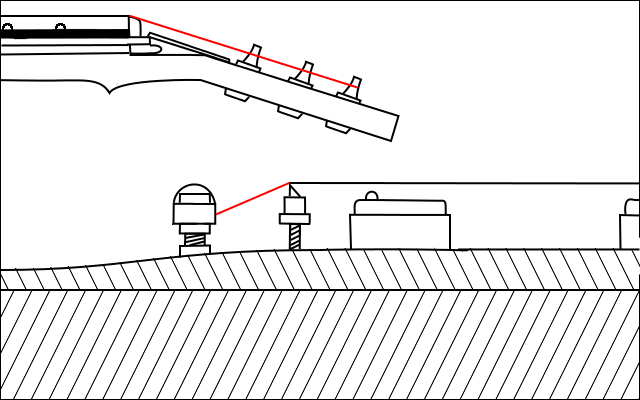
tune-o-matic bridge as shown in fig 1, has a bridge and tail piece.
The bridge as most people are aware, adjusts the string height and
intonation. The tail piece is the anchor point to hold the strings,
however it is also adjustable. This is to adjust the “break
angle”, the red part of the string in figure 1, just
before the string goes over the bridge saddle. Adjusting the break
angle can change the feel of the guitar. The guitar actually has two
break angles usually. Most guitars have one at the headstock, where
the strings pass over the nut and into the tuning pegs. This effects
the feel of the strings when bending them and attacking them. Some
bridges don't have a break angle. They are simply fixed to the
bridge. On Floyd Rose locking bridge systems, the guitar actually
has no break angles, because the guitar strings are locked in place.
So lets look at the
adjustment options of the break angle at the bridge:
 |
| Fig. 2 |
-
With the tail piece adjusted all the way to the guitars body, you increase the break angle and make it steeper, which increases the downward force on the bridge. Like the string in fig 2 B. A steeper break angle will make strings harder to bend and I've notice a bit more treble in the attack of the string.
- Conversely, adjusting the tail piece higher will decrease the break angel, decease the downward force on the bridge, making it less steep, like in fig 2 A. The strings will be easier to bend, and you might find you can attack the strings a bit softer. I have noticed a slight decrease in treble, with a higher break angle.
The break angle does
not adjust tension. Tension for a string to hold a pitch doesn't
change. The scale length of a guitar will effect tension. However,
that is not adjustable. A short scale guitar will require less
tension than the pitch on a long scale guitar. This is why some
people prefer certain scales and brands of guitars. Think of the
break angle as slack in a rope. The less force on the bridge and
less break angle, the easier the strings will slide over the saddles
and nut while bending a string.
So that's the
tune-o-matic bridge, but an even lesser know adjustment is available
on most Telecasters. I had a Tele that I was always fighting with.
I would break strings like crazy. I finally decided to stop
stringing the strings through the body. I though the holes the
strings were coming through might have been breaking the strings
anyhow. However after stringing the strings on the top of the
bridge like in fig 2A, I realized I changed the feel of the guitar
and changed the break angel. Now the guitar is easier to bend
strings on, and I even pick it a bit lighter. I did notice a slight
loss in treble, but nothing drastic. So it seems Fender gives you a
break angle option.
Now, I know there
are many people who strongly believe that string-through guitars and
tail pieces being all the way down on the body increases sustain. I
can't really disprove this, however I will say it's probably like
splitting hairs. The difference is minute as best. You many hear
a difference in tone. I tend to find the more force there is on the
bridge the more treble and attack you get. It should be said that
too steep of a break angle can sometimes cause problems with bending
bridges over years. The string-through bodies as well, might just be
marketing, claiming it increases sustain. I didn't find any proof of
this on my Tele. Maybe I'll do a test on that soon. I do like the
option to switch stringing like on most Telecasters. Also, I no
longer have to worry about losing the small metal ferrules after a
string breaks.
Hope this helps some
people. Just another option in getting your guitar to feel the way
you want it to.
Tuesday, January 19, 2016
New Pedal Paint Jobs

 Finally got some paint on the Harmonic Fucker (aka Harmonic Percolator
Clone). I made it a nod to Big Black's "Songs About Fucking". It sounds as nasty as ever. I also managed to find a use for some low output germanium Russian transistors (MP37). I made a hybrid silicon/germanium fuzz face, with a switching option for full germanium or half. Basically a high gain output, and low gain. I call it "the Hige Fuzz". Hige meaning "facial hair" in Japanese. I think it turned out nicely. I made a few for some friends as Christmas presents. I've got an order to make one for sale soon as well. You can check out how it sounds with my crappy demo video below.I'm hoping to finish up a large much-option auto-wah. With attack-wah, auto-wah, and cocked-wah options. We'll see. On paper it seems like a good idea.
Finally got some paint on the Harmonic Fucker (aka Harmonic Percolator
Clone). I made it a nod to Big Black's "Songs About Fucking". It sounds as nasty as ever. I also managed to find a use for some low output germanium Russian transistors (MP37). I made a hybrid silicon/germanium fuzz face, with a switching option for full germanium or half. Basically a high gain output, and low gain. I call it "the Hige Fuzz". Hige meaning "facial hair" in Japanese. I think it turned out nicely. I made a few for some friends as Christmas presents. I've got an order to make one for sale soon as well. You can check out how it sounds with my crappy demo video below.I'm hoping to finish up a large much-option auto-wah. With attack-wah, auto-wah, and cocked-wah options. We'll see. On paper it seems like a good idea. 

Saturday, January 16, 2016
2016 and Shows Coming up.

Man 2016 has been a bummer so far. First Lemmy then Bowie. Hard to sum up the impact those guys have had on me and millions of others. We're going to try to put together some sort of musical tribute to Motorhead at our(Godzilla Snacks) next show (Jan30th @Marcus). Inoue from Folk Enough has put together another festival April 29th at Utero. Probably about 17 bands in 12 hours, just like the last one. We had a blast at the last one.
Hopefully the band will have a second CD done, and I'll finish a solo CD finally in 2016. We'll see. It's probably going to be a busy year.


Sunday, September 27, 2015
White Mystery, Don Matsuo / Zoobombs, Japan Tour

Friday, September 25, 2015
Freaks!!! 9/21 and Marcus 10/03
Holy fuck! The Utero show was a fucking blast. A lot of great bands and people there. I was blown away by Chainsaw TV, and Folk Enough was nice enough to play "Momma Shit" for me. There was even this piece of insanity I got to play bass for at the end of the night.
We're (Godzilla Snacks) starting with a new bassist (Nobuto) in November, for a potentially big show. Until then, next weekend, Oct 3rd, we'll be in Marcus Kurosaki as a two-piece: Godzilla Snacks Lite.Again tons of thanks to Inuoe-san, who organized the event last week. 12 hours, 14 bands, and it was pulled off. Hope to do it again soon.

Tuesday, August 18, 2015
Lesser Know Channel Switching Ideas.
If you're like me, you've been through a few rigs or you've at least re-designed it more than a few times. I big part of music I love, is the use of dynamics. Soft to loud, loud to soft. It's a big part of the emotional part of music. I often have done what many people do in modern times to get these dynamics with an electric guitar and amp. Either used a boost or distortion/fuzz pedal on a clean amp, or simply use the footswitch on my two channel amp. Pretty simple. However I've been in situations where the I'm playing through a "Fender" style two channel amp with no footswitching abilities, or with an amp that is a simple one channel amp, and I'd like a quicker volume control than simply using the guitar's volume knob.
So how do we make a footswitch like channel switch on an amp with no footswitch? There are a few simple ways which I've learn from people much older and wiser than me.
 The first technique is actually the oldest idea. Before there were fuzz pedals or boost pedals, players only had a volume knob. Gibson guitars actually gave you two channels on their guitars by giving you two volume knobs, one for the bridge pickup and one for the neck. They actually named these "channels" on their toggle switches as "rhythm (neck PU)" and "lead (bridge PU)" The intended idea behind this is to dial in your basic tone on the amp with the neck(rhythm) pickup with the volume down enough to barely break up the amp. When you switch to the bridge (lead) pickup the volume will be fully open and much louder and more distorted. However it will be much brighter, that's when you'll need to turn down the "tone" knob to cut enough treble as you desire. This technique works pretty well, and I've used it quite a bit in situations with no pedals and only a Gibson on a good amp. I love where the toggle switch is on a Les Paul. You can really hit it on the fly with your thumb. Most of the guys you probably love from the classic rock era of the 60s and 70s probably started out this way, or continue to use this technique. check out Page demonstrate it here:
 The next idea uses a two channel, non-switchable amp such as a Fender Reverb. There are a ton of amps modeled after this amp and you've probably seen quite a few. The amp actually has two sets of two inputs, for each channel. To make this switchable by a footswitch, all we need is an ABY box. A pedal which enables us to spit a signal and gives us the ability to switch between the two channels. We can set each to different volumes or EQs and have two tones that are switchable by foot. Simple.

Lastly, we have an interesting idea which actually is similar in principle to the first technique. We'll simply cut the volume of an amp by using an EQ pedal. For years I always used the EQ as a boost. However most EQ pedals also allow you to cut the volume as well. The great part about this is we can shape the tone of the cut signal to customize it better. EQ pedal off, gives us our loud full volume tone. EQ on, gives us a clean channel. I personally like to add a compressor to the clean signal to give it a bit more sustain and fullness.
Even if you're happy with your setup as is right now, it's always good to have the knowledge of other ideas You never know when you might need to use them. I've played shows where most of my pedals aren't working or a cable has gone bad, and I've had to resort to some of these techniques.

So how do we make a footswitch like channel switch on an amp with no footswitch? There are a few simple ways which I've learn from people much older and wiser than me.
 The first technique is actually the oldest idea. Before there were fuzz pedals or boost pedals, players only had a volume knob. Gibson guitars actually gave you two channels on their guitars by giving you two volume knobs, one for the bridge pickup and one for the neck. They actually named these "channels" on their toggle switches as "rhythm (neck PU)" and "lead (bridge PU)" The intended idea behind this is to dial in your basic tone on the amp with the neck(rhythm) pickup with the volume down enough to barely break up the amp. When you switch to the bridge (lead) pickup the volume will be fully open and much louder and more distorted. However it will be much brighter, that's when you'll need to turn down the "tone" knob to cut enough treble as you desire. This technique works pretty well, and I've used it quite a bit in situations with no pedals and only a Gibson on a good amp. I love where the toggle switch is on a Les Paul. You can really hit it on the fly with your thumb. Most of the guys you probably love from the classic rock era of the 60s and 70s probably started out this way, or continue to use this technique. check out Page demonstrate it here:

Lastly, we have an interesting idea which actually is similar in principle to the first technique. We'll simply cut the volume of an amp by using an EQ pedal. For years I always used the EQ as a boost. However most EQ pedals also allow you to cut the volume as well. The great part about this is we can shape the tone of the cut signal to customize it better. EQ pedal off, gives us our loud full volume tone. EQ on, gives us a clean channel. I personally like to add a compressor to the clean signal to give it a bit more sustain and fullness.
Even if you're happy with your setup as is right now, it's always good to have the knowledge of other ideas You never know when you might need to use them. I've played shows where most of my pedals aren't working or a cable has gone bad, and I've had to resort to some of these techniques.

Monday, July 27, 2015
Freaks! Live festival. More shows, Portland....

In Portland in August. September 21st, doing a 14 band festival back in Japan, and new recordings from multiple projects possibly soon, and rehearsals. Busy..........
A few songs from an acoustic show a few weeks ago.
Sunday, July 5, 2015
Upcoming Live Schedule

A busy summer, but I'm thankful I have anywhere to play considering my constant blowups about the situation here. Going to be back in Portland in August. Salvador reunion? A BIG maybe, but a maybe. I've been practicing. Godzilla Snacks has a show July 26th in Kurosaki, and we're going to play with Inoue from Folk Enough, who is putting on an all-day festival Sept 21st at Utero. Cheap and fun. Looking forward to it. Folk Enough has played with some great bands like Sebadoh. Also, I started playing bass in a band called "The MSGs". We played a show last month, you can check that out here:
Solo acoustic show coming up as well. Might play everything from Roky Erickson to Willie Nelson, and some originals I haven't recorded yet. Still experimenting with live streaming. So some of these shows might go live via the internet. We'll see. Can't wait to see everyone back in Portland!
Upcoming live schedule:
Japan
- 07/18/2015 @Gigi Fukuoka, Solo
- 07/26/2015 @Marcus Kurosaki, Godzilla Snacks w/Grufftone, K3K,
柴田将吾(セルジプシー) - 09/05/2015 @Peace Fukuoka, The MSGs w/Titty Twister
- 09/21/2015 @Utero Fukuoka, Godzilla Snacks w/Folk Enough
- 09/22/2015 @Cube Studio Fukuoka, Playing bass with The MSGs
U.S.A.
- 08/07/2015 - 08/16/2015 Portland Or. Anything could happen...Salvador?
Monday, May 25, 2015
So playing music in Japan.....
I thought I'd write a little review of my experience as an
American/foreigner being in a band in Japan. I should note, that since I had both good and bad experiences, I managed to
met some very nice people who have helped me. Music is very much loved here, but it seems like most things here, change is a slow process.
The hardest two things about playing music here is getting band members together, and avoiding the pay-to-play, aka "Noruma." A system that is set in most Japanese cities, where a band must sell a minimum number of tickets, it recoup the cost. Pay-to-play basically. You can read more about it here: http://www.japantimes.co.jp I've heard many excuses for this system, but none seems to make total sense. Rent is high here, but venues should move out of downtown, if that were the case. There is some indie music support here, but not many people are willing to spend 2500yen($25) ticket prices for underground local bands. It seems even the cultural mind of many Japanese believe high ticket prices equals quality, yet with a cheap cover, most people here would seem to assume the music most be bad. Most of these venues rely on ticket sales and very little on the bar, unlike most venues in the States and Europe. So yeah, the business side of things is pretty wacky. The worst part of this system is that few bands are willing to help each other out, and sometimes it even pits bands against each other. Everyone is too worried about covering their quota, than to advertise other bands on the bill.
I fell for playing a Noruma gig once. My first show, with a short lived band I put together. I had been working for over a year with a singer, and after 5 bassists and 2 drummers we finally had a show. (In our case 15 tickets at 1500 yen, which roughly equals $15) Times this revenue by 3 bands and the empty venue is making at least $675 off the bands not counting the bar sales, which also was only being frequented by the bands. This system failed in most places in the US because bands got together and rented out warehouses and parties to bypassed the blood sucking venue owners. Here’s the run down of my 1st show playing in Japan.
The show opened at 6pm. This is pretty damn early, some people aren't even off work yet. I do understand shows ending before 12 because of the train schedule, but this was pretty damn early. The bass
player and I were up earlier because, we had no car and I owned all the equipment. He came over to
help take some of it to the venue. We arrive to the venue at about 3pm. Nothing too strange, but there
was and orientation of how things were going to go that night and a bowing season at the end. It was
very formal. All the bands stood in an awkward circle and bowed for awhile. We were then told of “the rules”. At 4pm we do a sound check. I guess each band gets one, so that is actually really nice. I quickly go home to take a shower because the 99% humidity and high temperatures have turned the band and myself into sloppy messes.
The first band goes on at 6:30 sharp. This is fucking early. All the members of the first band are about 16 years of age and no one is watching them other than my band. I mean not a single ticket payer is
present in the building at this point. Worrisome. The other band is not visibly present, so I check the
“green room.” I’m use to seeing a fair share of coke, booze, and all out insanity in backrooms. This was insanity of a different sense. I walk in to see young men applying foundation, hairspray, and
dressing up in costumes. Now, I understand some bands need make up. But we’re not talking Kiss here. This venue doesn't resemble a TV program which requires any of this nonsense. Actually, no one is in the audience to see either band. I can only assume this show is for their own self image and ego boosting. They then took stage like a band that was playing Madison Square, yet no one was watching them. Not even us. We were already pretty turned off from all we had witnessed. We left to drink outside on the street and to wait to sell tickets on our own. We were also responsible to sell our own tickets. Which meant we had to siphon off people at the door to buy our tickets from us and not from the general admission ticket booth just behind us at the entrance. These were the ONLY tickets sold to real people mind you. We spent about an hour in the heat selling tickets, like sideshow peddlers. The show however was running way early and most of our people hadn’t arrived yet. We were told to play at 8. It was 7. We procrastinated enough to sell enough ticket to brake even and sold enough to not owe anything to the venue.
We finally started to set up on stage REAL SLOWLY. All of our people made it. We played. Things went well, we had a crowd and some people saw us. That part was fun. People cared, which was nice. I can’t even fathom why, or even how the other band from Tokyo could afford to pay for getting across the country only to end up paying $225. No clue how the 16 year old kids could pay for their their share of the tickets. Rich parents? I just don’t get it. If this is what makes people happy with themselves then I guess that’s ok. If that’s the way it is, then underground music is being strangled to death in Japan and may never recover. I hope more bands start looking elsewhere to play. Rent out rehearsal studios? Might be the only shred of anything "punk" that was ever here.
The hardest two things about playing music here is getting band members together, and avoiding the pay-to-play, aka "Noruma." A system that is set in most Japanese cities, where a band must sell a minimum number of tickets, it recoup the cost. Pay-to-play basically. You can read more about it here: http://www.japantimes.co.jp I've heard many excuses for this system, but none seems to make total sense. Rent is high here, but venues should move out of downtown, if that were the case. There is some indie music support here, but not many people are willing to spend 2500yen($25) ticket prices for underground local bands. It seems even the cultural mind of many Japanese believe high ticket prices equals quality, yet with a cheap cover, most people here would seem to assume the music most be bad. Most of these venues rely on ticket sales and very little on the bar, unlike most venues in the States and Europe. So yeah, the business side of things is pretty wacky. The worst part of this system is that few bands are willing to help each other out, and sometimes it even pits bands against each other. Everyone is too worried about covering their quota, than to advertise other bands on the bill.
I fell for playing a Noruma gig once. My first show, with a short lived band I put together. I had been working for over a year with a singer, and after 5 bassists and 2 drummers we finally had a show. (In our case 15 tickets at 1500 yen, which roughly equals $15) Times this revenue by 3 bands and the empty venue is making at least $675 off the bands not counting the bar sales, which also was only being frequented by the bands. This system failed in most places in the US because bands got together and rented out warehouses and parties to bypassed the blood sucking venue owners. Here’s the run down of my 1st show playing in Japan.
The show opened at 6pm. This is pretty damn early, some people aren't even off work yet. I do understand shows ending before 12 because of the train schedule, but this was pretty damn early. The bass
player and I were up earlier because, we had no car and I owned all the equipment. He came over to
help take some of it to the venue. We arrive to the venue at about 3pm. Nothing too strange, but there
was and orientation of how things were going to go that night and a bowing season at the end. It was
very formal. All the bands stood in an awkward circle and bowed for awhile. We were then told of “the rules”. At 4pm we do a sound check. I guess each band gets one, so that is actually really nice. I quickly go home to take a shower because the 99% humidity and high temperatures have turned the band and myself into sloppy messes.
The first band goes on at 6:30 sharp. This is fucking early. All the members of the first band are about 16 years of age and no one is watching them other than my band. I mean not a single ticket payer is
present in the building at this point. Worrisome. The other band is not visibly present, so I check the
“green room.” I’m use to seeing a fair share of coke, booze, and all out insanity in backrooms. This was insanity of a different sense. I walk in to see young men applying foundation, hairspray, and
dressing up in costumes. Now, I understand some bands need make up. But we’re not talking Kiss here. This venue doesn't resemble a TV program which requires any of this nonsense. Actually, no one is in the audience to see either band. I can only assume this show is for their own self image and ego boosting. They then took stage like a band that was playing Madison Square, yet no one was watching them. Not even us. We were already pretty turned off from all we had witnessed. We left to drink outside on the street and to wait to sell tickets on our own. We were also responsible to sell our own tickets. Which meant we had to siphon off people at the door to buy our tickets from us and not from the general admission ticket booth just behind us at the entrance. These were the ONLY tickets sold to real people mind you. We spent about an hour in the heat selling tickets, like sideshow peddlers. The show however was running way early and most of our people hadn’t arrived yet. We were told to play at 8. It was 7. We procrastinated enough to sell enough ticket to brake even and sold enough to not owe anything to the venue.
We finally started to set up on stage REAL SLOWLY. All of our people made it. We played. Things went well, we had a crowd and some people saw us. That part was fun. People cared, which was nice. I can’t even fathom why, or even how the other band from Tokyo could afford to pay for getting across the country only to end up paying $225. No clue how the 16 year old kids could pay for their their share of the tickets. Rich parents? I just don’t get it. If this is what makes people happy with themselves then I guess that’s ok. If that’s the way it is, then underground music is being strangled to death in Japan and may never recover. I hope more bands start looking elsewhere to play. Rent out rehearsal studios? Might be the only shred of anything "punk" that was ever here.
Subscribe to:
Posts (Atom)